
Peppol
- Request Peppol activation
- UBL invoice format
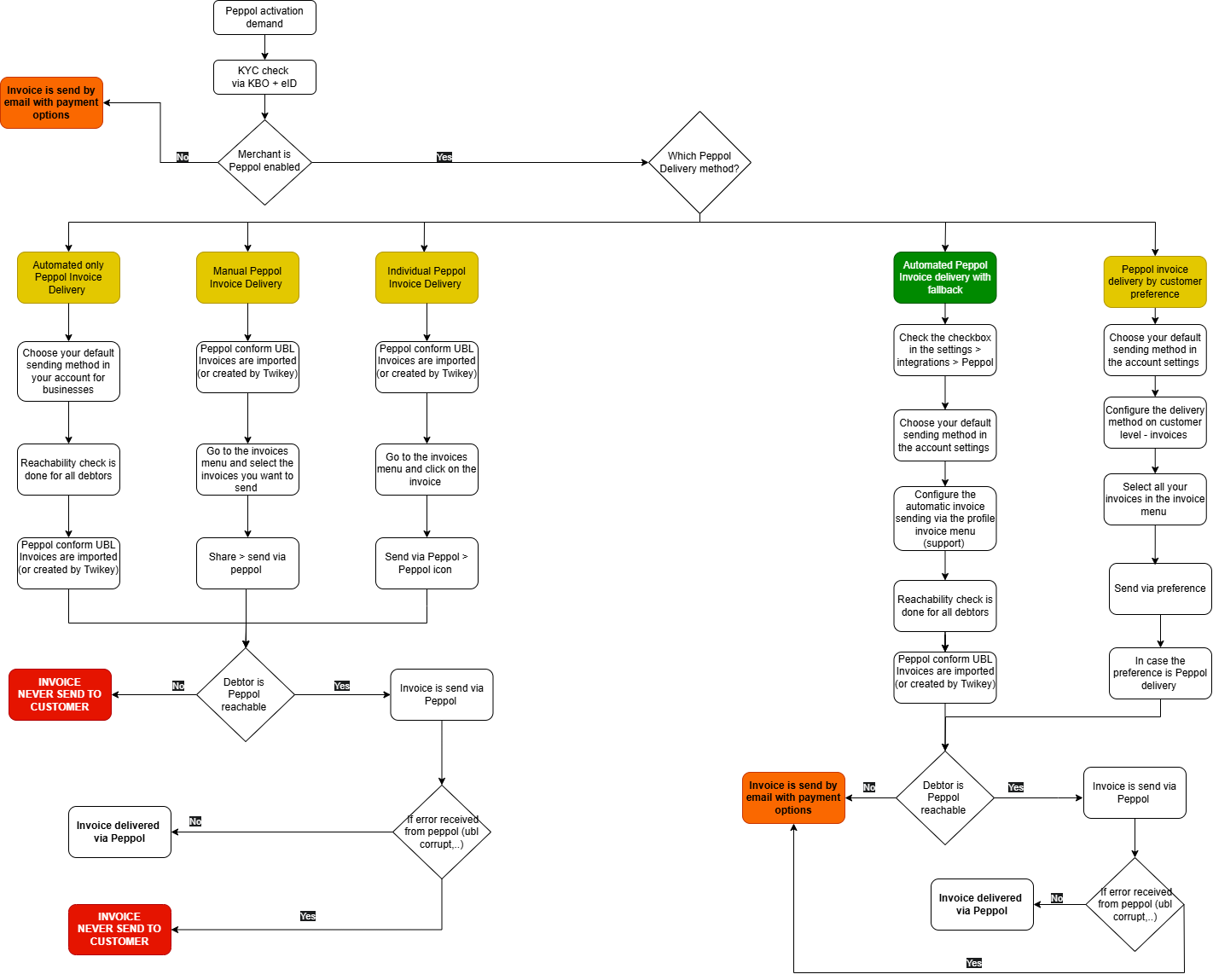
- Flowchart Peppol
- Is Twikey an Access Point?
- When is sending via Peppol mandatory?
With Twikey, you can send UBL invoices directly over the Peppol network. This simplifies your invoicing process and ensures compliance with international standards.
To activate Peppol, please follow the steps below. After activation, an additional configuration step is required before you can start sending invoices.
Request Peppol activation
To start, click the “Request Peppol activation” button via the menu integrations.
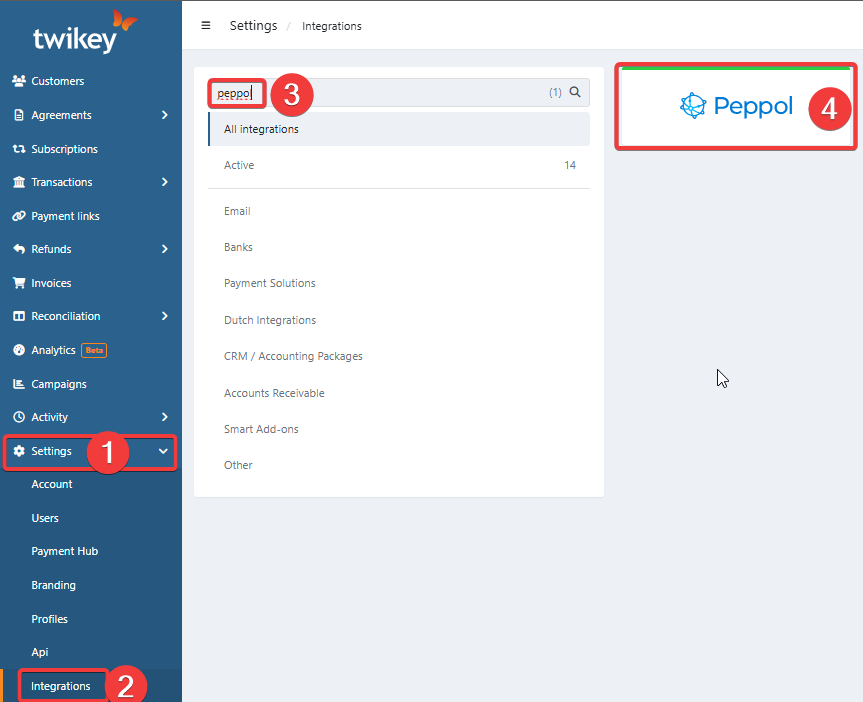
Our support team will contact you and request:
- An extract from the (Belgian) Crossroads Bank for Enterprises (KBO/KVK/COC/...). Tip: share this with us upfront to save time.
- A copy of the ID of the “Managing Director / Permanent Representative” mentioned on the extract.
Once the activation and KYC check are completed, you will receive an automated confirmation. We will then verify which of your existing clients are already reachable on Peppol.
You can check this in your client list using the filter Reachable on Peppol = Yes.
UBL invoice format
Invoices must be in a Peppol compliant UBL format.
Peppol ensures smooth communication by requiring all documents exchanged on its network to follow a standardized structure. This structure is defined in the Peppol Business Interoperability Specifications (BIS) and is based on Universal Business Language (UBL) 2.1.
In Belgium, the most commonly used standard is Peppol BIS Billing 3.0. You can read more about it here.
Please note that, according to the specifications, an invoice in UBL format must include a UBL address. If this address is missing, the invoice will automatically be sent by email instead.
To send your invoices via Peppol & Twikey, you will need either:
Option 1 : You already have a UBL/Peppol file
ℹ️ Please share an example of your UBL file with us so we can check compatibility.
⚠️Important : Twikey only validates the format, adaptations must be handled by the creator of your UBL file.Option 2 : You don’t have a UBL/Peppol file
If you or your invoice/accounting system cannot generate a Peppol compliant UBL, Twikey can create the UBL for you.
To do so, we’ll need the invoice data in an alternative format. You provide us the information via our invoice API and initiate the sending via Peppol.
Is Twikey an Access Point?
Twikey acts as a Peppol orchestrator and can connect with multiple Access Points.
When is sending via Peppol mandatory?
E-invoicing obligations differ per country and depend on where you and your customer are established.
Belgium — structured electronic invoicing is mandatory for domestic B2B invoices between Belgian VAT-registered businesses since 1 January 2026. Peppol is the default network for this.
France — all French businesses must be able to receive structured e-invoices for domestic B2B from 1 September 2026. Issuing is phased in: from 1 September 2026 for large and mid-sized companies, and from 1 September 2027 for small and micro companies. France routes invoices through certified partner platforms (PDP), for which Peppol can be used as one of the channels.
Germany — German businesses must be able to receive structured e-invoices for domestic B2B since 1 January 2025. The obligation to issue them is phased in: from 1 January 2027 for companies with an annual turnover above €800,000, and from 1 January 2028 for all German B2B invoices.
Cross-border invoices are treated differently from domestic ones, and the rules continue to change. Check with your accountant or tax adviser which obligations apply to your business.
Regardless of the obligation, sending via Peppol is available for any customer who is reachable on the network.