
Signing options by agreement type
- SEPA CORE/B2C (Business to Customer)
- SEPA B2B (Business to Business)
- PAD (Pre-Authorized Debit — Canada)
- Recurring credit card
- Contract
In Twikey, there are different paths to sign an agreement. The path taken depends on:
- The type of agreement (CORE/B2C, B2B, PAD, contract, etc.)
- The debtor's country
- The bank's connectivity & policy (for example: is it digitally connected to Twikey?)
- The configurations within your Twikey environment
SEPA CORE/B2C (Business to Customer)
A SEPA CORE agreement is signed digitally by the debtor, without the bank-connectivity restrictions that apply to B2B agreements below — it works with any bank in the SEPA zone. Depending on which mechanisms are activated on your profile, a CORE mandate can be signed with:
- itsme — Belgium, Netherlands, Luxembourg.
- eID — Belgium only.
- iDIN — Netherlands only.
- eMachtiging (Digitaal Incassomachtigen) — Netherlands only.
- Bank card (Debit Visa, Debit Mastercard, Visa, Mastercard) — Belgium, Netherlands, and other SEPA countries. This confirms the debtor's identity through their card issuer to sign the mandate — it is a signing method, not a payment, so the card is not charged.
- Bancontact Pay (first payment) — Belgium only.
- iDEAL | Wero (first payment) — Netherlands only.
- SMS — Belgium, Netherlands, and other SEPA countries.
- Wet signature — Belgium, Netherlands, and most countries globally.
- Open Banking Check (shown as Open Banking (Account Information) in your profile) — SEPA countries where at least one bank is connected; requires the Fraud module.
Learn more about SEPA CORE mandates. See Signing mechanisms for what each of these is, its reliability, best-use guidance, and how to activate it on your profile.
SEPA B2B (Business to Business)
A SEPA B2B agreement requires validation by the debtor's bank before it can be signed. Whatever the debtor's country or bank, there's always a signing path available — digitally where supported, or on paper everywhere else. Below you'll find the overview (you can click on the image to enlarge it):
Learn more about SEPA B2B mandates.
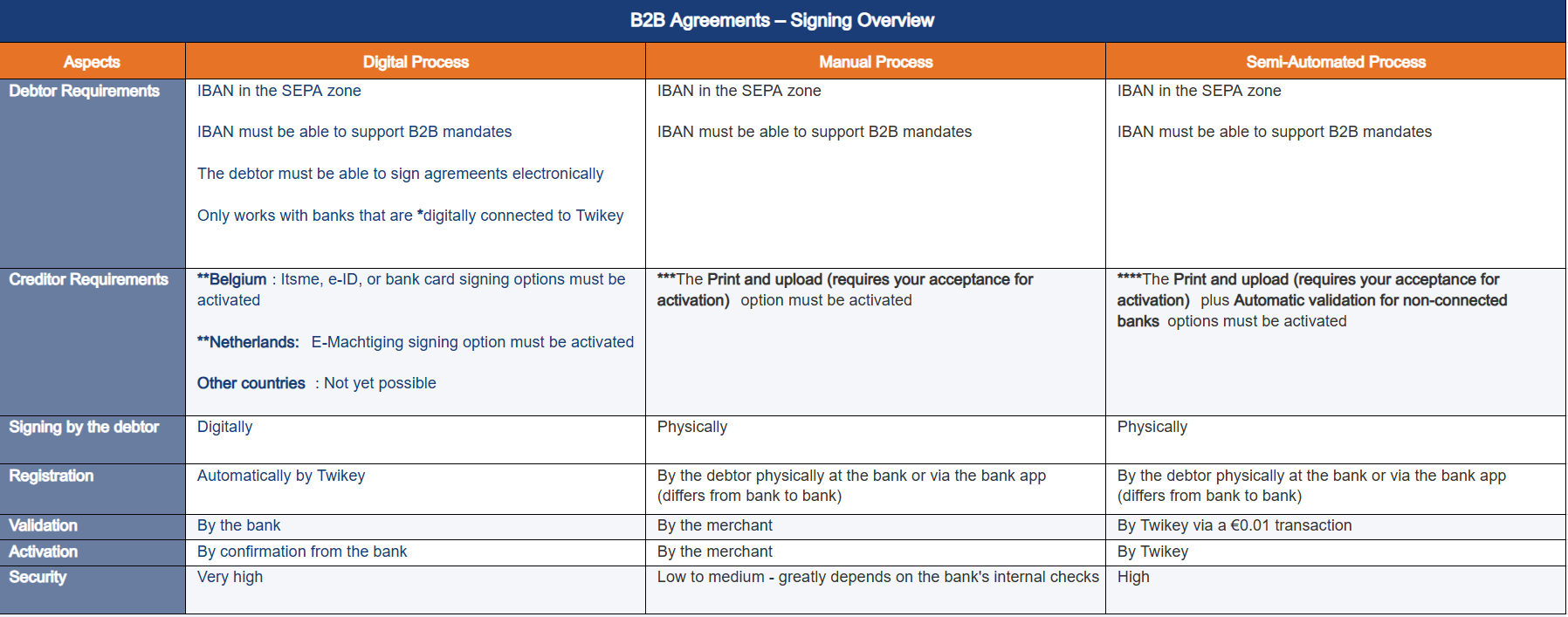
Digital signing — Belgium and Netherlands
When the debtor's bank is digitally connected to Twikey, the mandate is signed, validated, and activated fully online, with the highest level of security.
- Belgium — Sign via Itsme, e-ID, or a bank card (same identity check as for CORE above — no charge), provided the debtor's bank is on the list of digitally connected Belgian banks.
- Netherlands — Sign via E-Machtiging, provided the debtor's bank is on the list of digitally connected Dutch banks.
See our guide on signing mechanisms — activating these signing methods on your profile requires a request to your Customer Onboarding agent.
Paper-based signing — every other case
Use this path whenever digital signing isn't available: for debtors outside Belgium and the Netherlands, or for a Belgian or Dutch debtor whose bank isn't on the digitally connected list. The debtor signs the document on paper and returns it to you; who then validates it depends on which of the two options you enable.
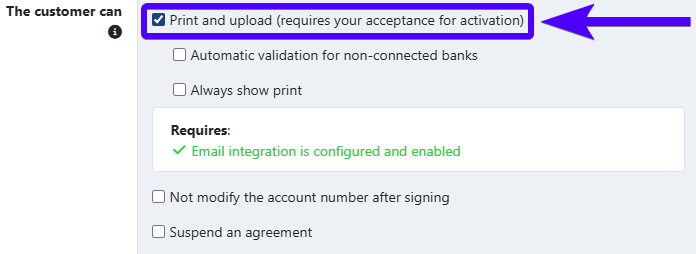
- Manual process — Enable Print and upload so the debtor can sign on paper and return the document by e-mail or upload. You validate the returned document yourself. See B2B paper signing for non-connected banks for the full flow.
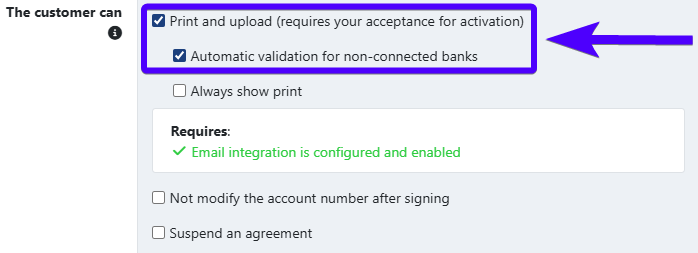
- Semi-automated process — Enable Print and upload together with Automatic validation for non-connected banks so Twikey validates the returned document automatically, via a €0.01 transaction, instead of you doing it manually. See B2B automated validation for non-connected banks for the full flow.
This means every debtor, in any SEPA country, has a working signing path: digital where the bank supports it, and paper — with or without automatic validation — everywhere else.
PAD (Pre-Authorized Debit — Canada)
A PAD agreement is signed as a written or electronic authorization, following Canadian banking rules rather than SEPA — use it for customers who bank in Canada and can't sign a SEPA mandate.
Setting this up requires a PAD authorization with your bank or payment provider, plus a dedicated PAD profile in Twikey — reach out to our support to configure this.
Learn more about PAD Direct Debit mandates.
Recurring credit card
A recurring credit card agreement isn't signed with a document — it's activated through the customer's first payment, using one of:
- Visa, Mastercard, Debit Visa, Debit Mastercard — Belgium, Netherlands, and other SEPA countries.
- PayPal — Belgium, Netherlands, and SEPA regions, among many other countries globally. Only available on Recurring credit card profiles, not on direct debit profiles.
Once that initial transaction succeeds, the resulting token can be reused for subscriptions or installment plans without asking the customer to sign or pay again.
Learn more about Recurrent Credit Card tokens. See Signing mechanisms for full detail on each of these.
Contract
Clients sign contract documents through a secure, fully digital online flow, with each signature fully traceable. Unlike the payment agreement types above, no bank or creditor contract is required before you can start collecting signatures.
Learn more about what a contract is.