
What is a SEPA B2B Direct Debit mandate
A SEPA B2B (Business-to-Business) Direct Debit mandate is a formal financial agreement specifically designed for transactions between companies. It allows you to automatically collect payments from your business customers' bank accounts with enhanced security and reduced refund risks compared to CORE mandates.
Key characteristics
Who can use it
B2B mandates can only be established between companies. Your customer must have a business bank account to use this mandate type. Note that some banks do not allow persons exercising a self-employed complementary activity to hold a business account, which means these individuals cannot conclude a B2B agreement.
Refund rights
Unlike CORE mandates, B2B mandates offer significantly reduced refund rights. Customers cannot request unauthorized refunds after authorizing a collection, providing greater payment certainty for your business.
Geographic reach
B2B mandates work across all SEPA countries, enabling you to collect payments from business customers throughout the eurozone and participating countries.
What do you need to get started
To manage SEPA B2B Direct Debit mandates with Twikey, you'll need:
Required documentation
Before contacting your bank, prepare the information they'll need: details about your organization, transaction volumes, and mandate type. Twikey can provide a specific document to help streamline this.A B2B creditor contract with your bank
Contact your bank's business or corporate banking department to set up a B2B Direct Debit creditor contract. They'll guide you through the application process.
For businesses in the Netherlands, you must also have a 'Digitaal Incassomachtigen' contract so your customers are able to sign their B2B mandate online.A creditor ID
Once your B2B creditor contract is approved, you'll receive a creditor ID that enables you to create and manage SEPA B2B Direct Debit mandates through Twikey.
Bank authorization
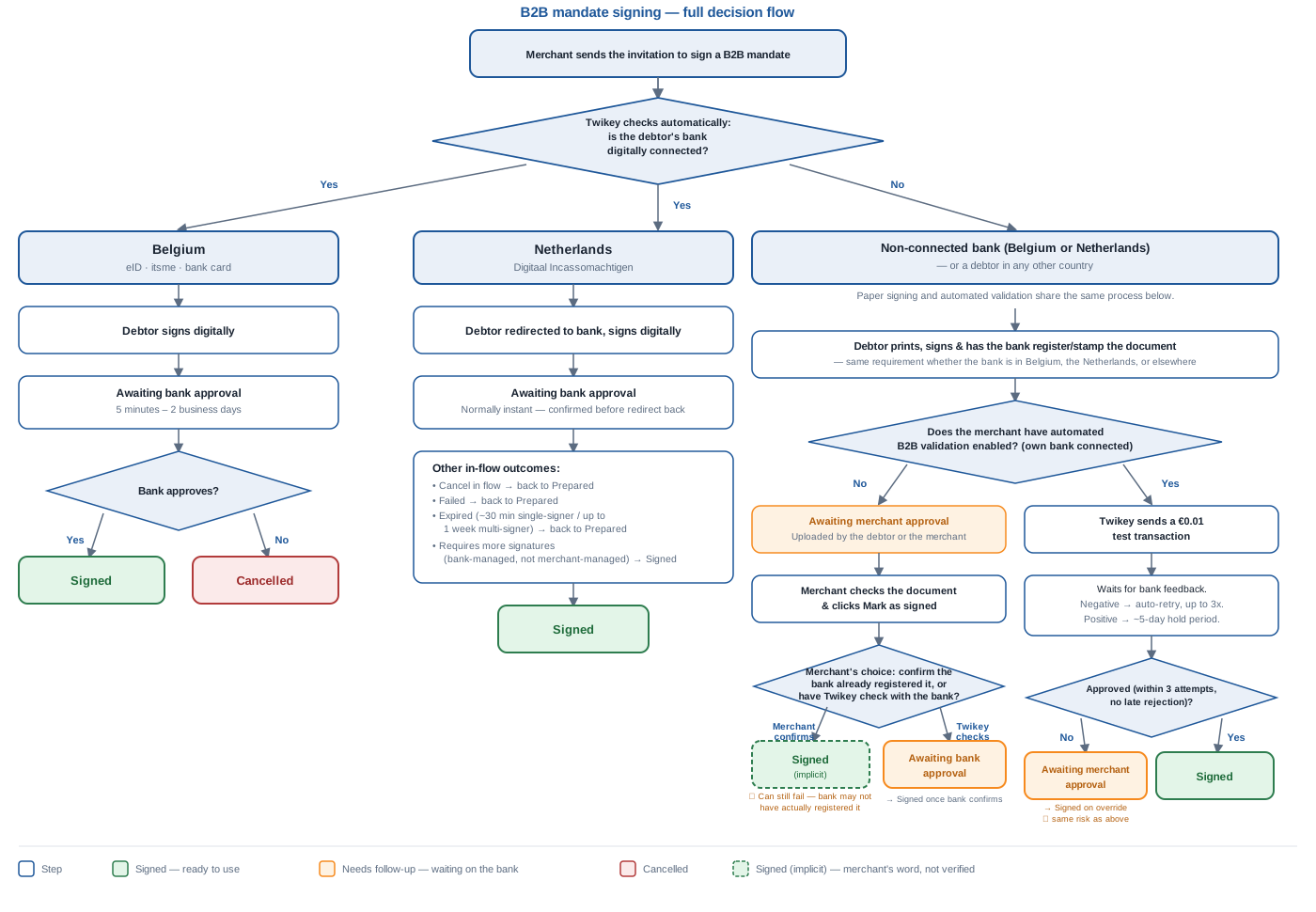
The steps above are about your own bank relationship. From here on, "the bank" refers to your customer's bank, not yours: B2B mandates require validation by your customer's bank before they can be used. With Twikey, B2B mandates can be signed online using the signing methods supported in each country. Please note that electronic signing of B2B mandates is not supported by all banks. Availability depends on the bank and the country of the debtor.
Two countries have electronic signing methods built into Twikey — find your customer's country below for the supported banks:
- B2B paper signing for non-connected banks — the customer visits their bank in person or through their banking app, and you confirm the registration yourself from the document they bring back.
- B2B automated validation for non-connected banks — Twikey confirms the registration for you automatically, using a small test transaction instead of a document.
The flowchart below ties all of the above together — the full decision flow, from invitation to a final Signed, Cancelled, or follow-up state:
Best practice recommendation
We encourage B2B companies to conclude both B2B and CORE creditor contracts with their bank. This allows you to use B2B mandates as your primary method while having CORE mandates available as a backup option for customers who cannot establish B2B agreements.